Pallet Repair Services
Extend the life of your pallets and save up to 60% compared to buying new. Our expert repair team restores damaged pallets to full working condition.
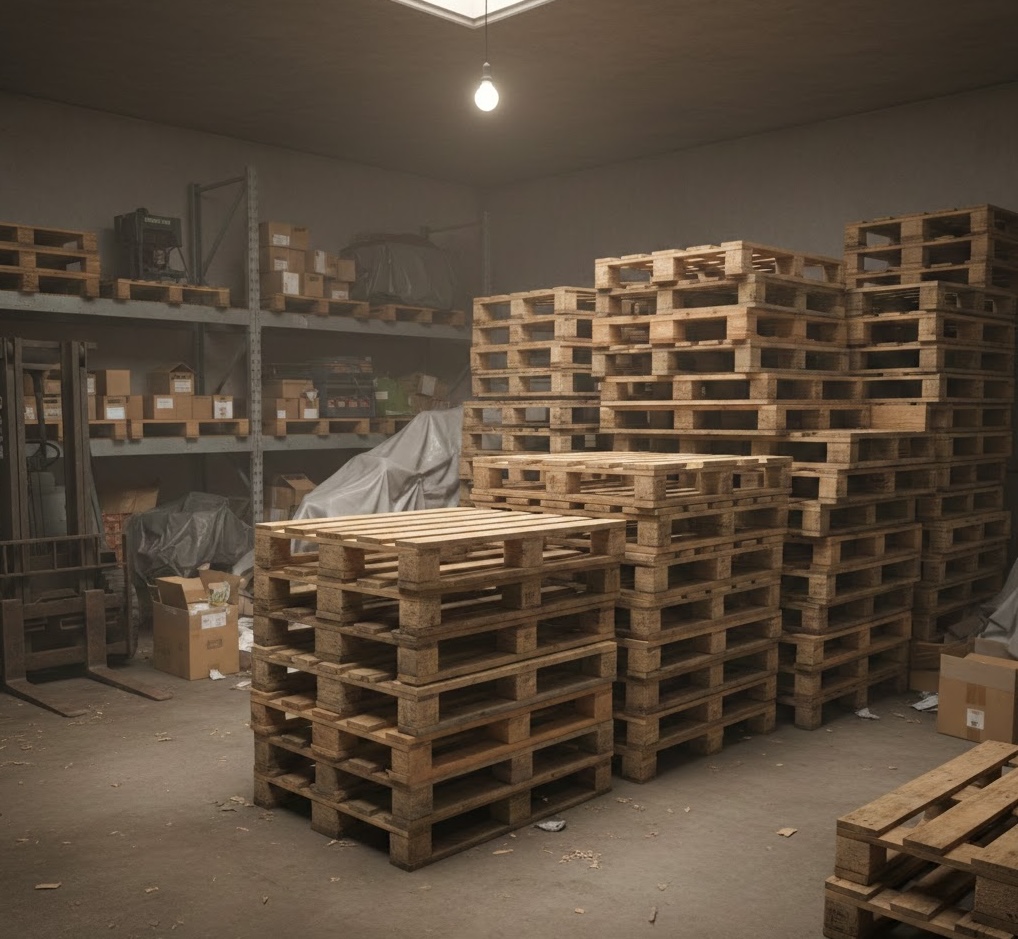
Professional Pallet Repair
Extend pallet life and save up to 60% compared to buying new
Request Repair Service
Tell us about your damaged pallets and we'll provide a repair estimate. Most repairs cost a fraction of replacement.
Frequently Asked Questions
What damage can you repair on pallets?+
We replace broken deck boards, fix stringers, and tighten fasteners to return pallets to safe working condition.
Is repair cheaper than buying new pallets?+
Yes. Repairing salvageable pallets can cut costs up to 60% versus purchasing new replacements.
Do repaired pallets meet industry grades?+
Repaired pallets are re-inspected and graded so you know whether they meet Grade A, B, or economy standards.
Can you pick up damaged pallets from our site?+
We can collect damaged pallets, repair them at our facility, and return ready-to-use inventory to you.
How long does the repair cycle take?+
Typical turnaround is 2–5 days depending on volume and transport distance; rush options are available.
Repair vs Replace: The Numbers
For most damaged pallets, repair is significantly cheaper than replacement. A typical repair costs 40-60% less than purchasing a new pallet of equivalent quality. When you multiply that across hundreds or thousands of pallets, the savings are substantial.
Beyond direct cost savings, repair extends the useful life of each pallet by 3-5 additional cycles, maximizes the return on your original pallet investment, and reduces waste going to landfills.
When to Repair vs Replace
Repair When:
- 1-3 boards are broken or missing
- Nails are protruding or loose
- A single stringer has a crack or split
- The pallet is structurally sound overall
- Cosmetic damage only (staining, scuffing)
Replace When:
- More than 50% of boards are damaged
- Multiple stringers are broken
- Severe structural compromise
- Contamination (chemicals, mold)
- Repair cost approaches replacement cost
Common Repairs We Perform
Our repair facility handles every type of pallet damage. Here are the most common repairs we perform daily.
Board Replacement
Broken, split, or missing deck boards are replaced with matching lumber. We stock all standard board dimensions to ensure seamless repairs that maintain the pallet's original specifications.
Nail & Fastener Repair
Protruding, bent, or missing nails are addressed. We use industrial pneumatic nail guns with ring-shank nails for superior holding power that exceeds the original fastening.
Stringer Repair
Cracked, split, or broken stringers are reinforced or replaced. Stringer damage is addressed with companion boards, metal repair plates, or full stringer replacement as needed.
Lead Board Repair
Lead boards (the outermost boards) take the most abuse from forklift entry. We replace damaged lead boards to restore forklift accessibility and structural integrity.
Block Replacement
For block-style pallets, damaged or crushed corner and center blocks are replaced with new blocks cut to exact specifications for proper load distribution.
Re-nailing & Tightening
Loose boards and joints are re-nailed to restore rigidity. Over time, wood shrinkage can cause connections to loosen, and re-nailing restores the pallet to working condition.
Repair vs Replace: Complete Guide
Not every damaged pallet should be repaired, and not every damaged pallet needs to be replaced. Use this comprehensive guide to make the smartest decision for each situation.
| Damage Scenario | Recommendation | Estimated Repair Cost | Reasoning |
|---|---|---|---|
| 1 broken deck board | Repair | $2.00 - $3.50 | Simple board replacement. Repair is 75-85% cheaper than buying a new pallet. |
| 2-3 broken deck boards | Repair | $3.50 - $6.00 | Still highly cost-effective. Pallet retains full structural integrity after repair. |
| Single stringer crack (partial) | Repair | $3.00 - $5.00 | Companion board or metal plate reinforcement restores full load-bearing capacity. |
| Protruding or missing nails | Repair | $1.00 - $2.50 | Quick, low-cost fix that eliminates a safety hazard and extends pallet life. |
| 4+ broken boards | Evaluate | $6.00 - $10.00 | Repair may still be cheaper, but the cost gap narrows. Evaluate based on pallet value. |
| Multiple stringer breaks | Replace | Exceeds threshold | Multiple stringer failures indicate structural compromise. Replacement is safer. |
| 50%+ boards damaged | Replace | Exceeds threshold | When repair cost exceeds 70% of replacement cost, buying new is more economical. |
| Mold or chemical contamination | Recycle | N/A | Contaminated pallets cannot be safely repaired for reuse. Route to recycling. |
Rule of thumb: If the repair cost is less than 70% of the replacement cost and the pallet is not contaminated, repair is almost always the smarter choice. Our technicians assess each pallet individually and will always recommend the most cost-effective option.
Repair Methods Explained
Our repair team uses proven techniques and industrial-grade tools to restore pallets to full working condition. Here is a detailed look at each repair method.
Board Replacement
Broken, split, or missing deck boards are removed and replaced with matching lumber. We stock a wide range of board dimensions in both softwood and hardwood to ensure seamless repairs. Replacement boards are cut to the exact length and width of the original board and secured with ring-shank nails for superior holding power.
Stringer Repair with Companion Board
When a stringer has a partial crack or split, a companion board (also called a repair plate or sister board) is nailed alongside the damaged section. This reinforces the stringer without requiring full removal and replacement. The companion board bridges the crack and distributes the load across the sound wood.
Full Stringer Replacement
Severely damaged stringers that cannot be salvaged with companion boards are completely removed and replaced with new or reclaimed stringers of matching dimensions. This is the most intensive repair but restores the pallet to full original specifications.
Re-Nailing & Fastener Tightening
Loose joints, protruding nails, and missing fasteners are addressed by re-nailing all connections with industrial-grade ring-shank nails. Ring-shank nails provide 40% more holding power than smooth-shank nails, often making the repair stronger than the original assembly.
Metal Plate Reinforcement
For stringer damage in load-critical areas, galvanized metal repair plates are installed across the crack or break. These plates are nailed to both sides of the damaged section, creating a rigid bridge that fully restores the stringer's load-bearing capacity.
Heat Treatment After Repair
Pallets that were originally heat-treated for ISPM-15 compliance must be re-treated after any repair involving untreated wood. We route these pallets through our heat treatment facility for re-processing and re-stamping before returning them to service.
On-Site Repair Services
For large operations with high volumes of damaged pallets, transporting them to our facility may not be practical. That is why we offer on-site repair services -- our mobile repair crews come to your location with all the tools and materials needed to repair pallets right at your facility.
On-site repair eliminates transportation costs, reduces turnaround time to zero, and allows repaired pallets to go directly back into service without ever leaving your premises.
Fully Equipped Crews
Each mobile repair crew arrives with pneumatic tools, compressors, replacement lumber, fasteners, and all necessary equipment. They are entirely self-sufficient.
High Daily Output
A two-person mobile crew can repair 200-400 pallets per day depending on damage severity. Larger crews are available for higher-volume facilities.
Minimal Disruption
Our crews work in a designated area of your facility. They require only a clear staging area and access to a power outlet for compressed air equipment.
Same-Day Turnaround
Repaired pallets are stacked and ready for use the same day. No waiting for pickup, transport, and return delivery.
Repair Turnaround Times
We offer three turnaround tiers to match your urgency level. Rush and emergency services are available for time-critical operations.
Standard
3-5 business daysPallets picked up, repaired at our facility, and delivered back. Most cost-effective option for non-urgent repairs.
Rush
24-48 hoursPriority queue at our repair facility. Pallets are repaired and returned within 1-2 business days. Rush surcharge applies.
Emergency
Same dayOn-site mobile crew dispatched to your facility for same-day repair. Available in most metropolitan areas with 4-hour response.
On-Site Program
OngoingPermanent or recurring on-site crew stationed at your facility on a weekly or daily basis for continuous repair support.
Quality Standards After Repair
A repaired pallet must perform identically to an unrepaired pallet of the same grade. Here is how we verify and certify repair quality.
Load Capacity Verification
Every repaired pallet is expected to meet its original rated static and dynamic load capacity. Repair techniques are specifically designed to restore -- and in some cases exceed -- the original structural performance.
Dimensional Tolerance Check
After repair, overall pallet dimensions are verified to ensure they remain within specification for racking systems, conveyor systems, and automated handling equipment.
Fastener Audit
All nail and fastener connections are inspected post-repair. We verify proper nail depth, correct ring-shank nail usage, and absence of any protruding or improperly seated fasteners.
Board Alignment Inspection
Replacement boards are checked for proper alignment with the existing deck pattern. Misaligned boards can cause load instability and automated system jams.
NWPCA Compliance Verification
All repairs are verified against National Wooden Pallet & Container Association standards for repair quality, fastener placement, and structural integrity.
Grade Re-Assignment
After repair, each pallet is re-graded. A well-repaired pallet can often be upgraded -- for example, a Grade C pallet with new boards may qualify as Grade B after repair.
The Repair Process
Every repair follows a rigorous quality-controlled process to ensure consistency and durability.
Assessment & Triage
Each pallet is individually inspected by trained technicians. We document the damage, determine if repair is cost-effective, and create a repair plan. Pallets beyond economical repair are routed to recycling.
Disassembly of Damaged Components
Broken boards, bent nails, and damaged components are carefully removed. We use pallet dismantling equipment that minimizes damage to surrounding good components.
Component Replacement
New or reclaimed lumber is cut to exact specifications and installed. Replacement boards are selected to match the existing pallet wood species and dimensions.
Fastening & Assembly
All new and existing connections are secured with industrial-grade ring-shank nails using pneumatic nail guns. Every joint is fastened to exceed NWPCA (National Wooden Pallet & Container Association) standards.
Quality Inspection
Every repaired pallet undergoes a final inspection. We check structural integrity, nail placement, board alignment, and overall condition. Only pallets that pass inspection are returned to service.
Our Quality Standards
We stand behind every repair. Our quality standards ensure that repaired pallets perform as well as new ones for their intended application.
NWPCA Compliance
All repairs follow National Wooden Pallet & Container Association guidelines for structural integrity, fastener placement, and load-bearing capacity.
Material Matching
Replacement lumber is selected to match the original wood species, thickness, and width. We stock a wide range of materials to ensure consistent repairs.
Ring-Shank Nails
We use ring-shank nails exclusively for all repairs. These nails provide 40% more holding power than smooth-shank nails, ensuring long-lasting connections.
Load Testing Standards
Repaired pallets are expected to meet the same static and dynamic load ratings as their original specifications. We test per industry benchmarks.
Visual & Structural Inspection
100% of repaired pallets receive both visual and structural inspection before release. No unit ships without passing our quality checkpoint.
Customer Specifications
If you have specific requirements for board thickness, nail patterns, or dimensions, we configure our repairs to meet your exact specifications.
Repair Is Green
Pallet repair is one of the simplest and most effective sustainability actions your business can take.
Repair vs Replace: Real Numbers
The financial case for pallet repair is compelling. Here is a detailed cost breakdown comparing repair to full replacement for common pallet types.
| Damage Type | Typical Repair Cost | New Pallet Cost | Savings Per Unit | Savings at 500 Units |
|---|---|---|---|---|
| 1-2 Broken Deck Boards | $2.50 - $4.00 | $11 - $15 | $7 - $13 | $3,500 - $6,500 |
| Protruding / Missing Nails | $1.00 - $2.00 | $11 - $15 | $9 - $14 | $4,500 - $7,000 |
| Single Stringer Crack | $3.00 - $5.00 | $11 - $15 | $6 - $12 | $3,000 - $6,000 |
| Lead Board Replacement | $2.00 - $3.50 | $11 - $15 | $7.50 - $13 | $3,750 - $6,500 |
| Block Replacement (1-2) | $3.50 - $5.50 | $13 - $18 | $7.50 - $14.50 | $3,750 - $7,250 |
| Full Re-nail & Tighten | $1.50 - $3.00 | $11 - $15 | $8 - $14 | $4,000 - $7,000 |
Average savings: A typical business repairing 500 pallets per month saves between $3,000 and $7,000 monthly compared to full replacement -- that is $36,000 to $84,000 annually.
Common Pallet Damage Types
Understanding the types of damage your pallets sustain helps you assess repair feasibility. Here are the most common damage patterns we see and their typical causes.
Forklift Tine Damage
The most common damage type. Forklift tines that miss the pallet opening crack or split lead boards, bottom deck boards, and stringers. Usually repairable with board or stringer replacement.
Broken Deck Boards
Top or bottom deck boards crack, split, or break entirely from loads exceeding the pallet rating, impact during transit, or poor stacking practices. Repaired by replacing individual boards.
Stringer Splits & Cracks
The three stringers running lengthwise carry the load. Repeated forklift lifting creates stress fractures that eventually develop into full splits. Repaired with companion boards or full replacement.
Missing Boards
Nails loosen over time and boards detach completely during transit or forklift handling. The pallet may still be structurally usable but is missing one or more boards. Simple board replacement repair.
Nail Pop / Protrusion
As wood dries and shrinks, nails that were flush become raised or protruding. Vibration during transit exacerbates this. A safety hazard that is quickly corrected by re-nailing with ring-shank nails.
Water & Weather Damage
Pallets stored outdoors absorb moisture, leading to warping, swelling, mold growth, and accelerated decay. Mild cases are repairable; severe rot or mold contamination may require recycling instead.
Repair Quality Guaranteed
We stand behind every repair we perform. If a repaired pallet fails in normal use within the warranty period, we replace it at no cost.
Structural Integrity Warranty
Every repaired pallet is warranted to perform at its rated load capacity for the duration of its next use cycle. If a repaired connection fails under normal operating conditions, we replace the pallet free of charge.
100% Post-Repair Inspection
No pallet leaves our facility without passing a multi-point inspection. We check every board, every nail, every stringer, and every joint before clearing it for delivery. Our rejection rate on repaired pallets is less than 1%.
Ring-Shank Nail Standard
We exclusively use ring-shank nails for all repair work. These nails provide 40% more withdrawal resistance than smooth-shank nails, meaning our repairs actually last longer than original factory assembly in many cases.
Customer Satisfaction Policy
If any repaired pallets in your shipment do not meet your expectations, contact us within 72 hours. We will send replacements or credit your account immediately, no questions asked.
Repair Capacity at a Glance
Repair FAQ
What is the minimum quantity for repair service?
Our minimum repair order is 25 pallets. This ensures efficient use of our repair crew and equipment. For quantities under 25, it may be more cost-effective to purchase replacement pallets from our used inventory.
Can you pick up damaged pallets and return them repaired?
Yes. We offer full round-trip logistics. Our truck picks up your damaged pallets, we repair them at our facility, and we deliver the repaired pallets back to you. Turnaround is typically 2-5 business days depending on volume and repair complexity.
How do you determine if a pallet should be repaired or recycled?
Our technicians assess each pallet individually. If the repair cost exceeds 70% of the replacement cost, or if more than 50% of the pallet components are damaged, we recommend recycling instead of repair. We always communicate this before proceeding.
Can you repair pallets to specific customer specifications?
Absolutely. If you require specific board thicknesses, nail patterns, wood species, or dimensional tolerances, we configure our repairs to meet your exact requirements. Many customers provide a repair specification document that we follow.
Do repaired pallets work with automated pallet handling systems?
Grade A repaired pallets are suitable for most automated systems including conveyor systems, automated storage and retrieval systems (AS/RS), and robotic palletizers. We can repair to the tighter tolerances these systems require when specified.
Is pallet repair really more sustainable than buying new?
Significantly. Repairing a pallet uses 85% less energy than manufacturing a new one, saves the equivalent of one tree per 5 repairs, keeps 30 pounds of wood per pallet out of landfills, and avoids 25 kg of CO2 emissions per unit. The sustainability case is clear.
Stop Replacing. Start Repairing.
Save money, reduce waste, and extend the life of your pallets. Contact us for a repair assessment today.