Plastic Pallets
Lightweight, hygienic, and built to last. Our plastic pallets are ideal for food processing, pharmaceuticals, clean rooms, and any application that demands superior cleanliness and durability.
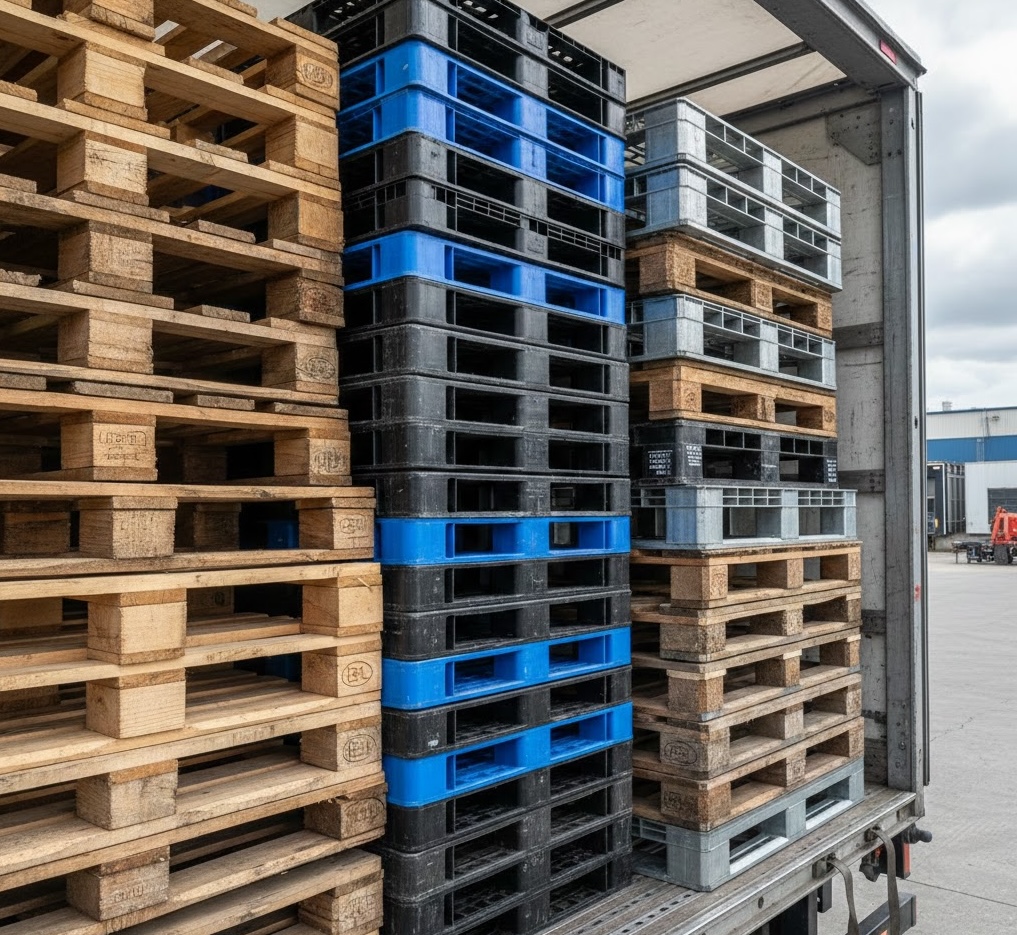
Durable Plastic Pallets
Hygienic, lightweight, and built to last for years
Get a Plastic Pallet Quote
Specify your type, size, and quantity. We'll provide pricing for new and recycled plastic pallets within 24 hours.
Types of Plastic Pallets
Plastic pallets come in three primary configurations, each designed for specific handling methods and storage requirements.
Nestable Pallets
Space-Saving Design
Designed with tapered legs that allow empty pallets to nest inside each other, reducing storage space by up to 75%. The most space-efficient option for return logistics and export shipping.
Key Features:
- Stacks 3:1 nesting ratio when empty
- Saves up to 75% storage space
- Lightweight (as low as 8 lbs)
- 9-leg or perimeter base designs
- Ideal for export and one-way trips
- No ISPM-15 treatment required
Stackable Pallets
Most Versatile
Feature a flat or reinforced bottom deck that allows loaded pallets to be stacked on top of each other. The most popular type of plastic pallet for warehouse operations and closed-loop supply chains.
Key Features:
- Stable stacking when loaded
- Flat bottom for conveyor compatibility
- Higher load capacity than nestable
- 4-way forklift and pallet jack entry
- Excellent for closed-loop systems
- Available with anti-slip surfaces
Rackable Pallets
Maximum Strength
Engineered with reinforced internal structures, often including steel rods, to support heavy loads on warehouse racking systems. The strongest and most durable type of plastic pallet.
Key Features:
- Designed for pallet racking systems
- Steel reinforcement available
- Highest dynamic and static load ratings
- Supports heavy racking loads unsupported
- Long-term investment (10+ year lifespan)
- Consistent dimensions for automation
Why Choose Plastic Pallets
Plastic pallets offer a range of advantages that make them the superior choice for many industries and applications.
Superior Hygiene
Non-porous surfaces resist bacteria, mold, and moisture. Easy to clean with water, steam, or chemical sanitizers. No splinters, nails, or wood debris to contaminate products.
Lightweight
Plastic pallets weigh 30-50% less than equivalent wood pallets. This reduces shipping costs, lowers fuel consumption, and makes handling easier and safer for workers.
Exceptional Durability
Plastic pallets last 10+ years with proper use. They resist moisture, chemicals, and UV exposure. No rotting, warping, or splitting like wood pallets.
No Splinters or Nails
Eliminate workplace injuries from splinters, protruding nails, and broken boards. Plastic pallets are smooth and uniform, significantly reducing handling injuries.
Consistent Dimensions
Injection-molded plastic pallets maintain exact dimensions over their entire lifespan. This consistency is essential for automated warehousing and robotic handling systems.
No Treatment Required
Plastic pallets are exempt from ISPM-15 heat treatment requirements, saving time and money on international shipments. No fumigation or stamps needed.
Industries We Serve
Plastic pallets are the preferred choice in industries where hygiene, weight, and consistency are critical requirements.
Food & Beverage
FDA-compliant plastic pallets meet strict food safety regulations. Non-porous surfaces prevent bacterial growth and are easy to sanitize between uses. Essential for FSMA compliance.
Pharmaceutical
Clean room-compatible pallets that meet GMP requirements. Consistent dimensions ensure compatibility with automated dispensing and packaging systems.
Electronics
Anti-static and ESD-safe options protect sensitive electronic components during storage and shipping. Dust-free surfaces prevent particle contamination.
Automotive
Durable plastic pallets withstand the demands of just-in-time manufacturing. Consistent sizing works seamlessly with automated assembly line systems.
Retail & E-Commerce
Lightweight plastic pallets reduce shipping costs for high-volume retailers. Nestable designs save space in return logistics and empty container management.
Chemical & Hazmat
Chemical-resistant plastic pallets safely transport hazardous materials. They won't absorb spills, simplifying cleanup and preventing cross-contamination.
Available Sizes
We stock the most commonly requested plastic pallet sizes and can source specialty dimensions from our manufacturing partners.
| Size (inches) | Type Available | Dynamic Load | Static Load |
|---|---|---|---|
| 48 x 40 | Nestable, Stackable, Rackable | 2,200 - 2,800 lbs | 5,000 - 8,000 lbs |
| 48 x 48 | Stackable, Rackable | 2,500 - 3,000 lbs | 6,000 - 10,000 lbs |
| 42 x 42 | Nestable, Stackable | 2,000 - 2,500 lbs | 5,000 - 7,000 lbs |
| 48 x 45 | Stackable, Rackable | 2,200 - 2,800 lbs | 5,500 - 8,000 lbs |
| 40 x 48 | Nestable, Stackable | 2,000 - 2,500 lbs | 5,000 - 7,000 lbs |
| 36 x 36 | Nestable, Stackable | 1,500 - 2,000 lbs | 4,000 - 6,000 lbs |
| Half Pallet | Nestable, Stackable | 1,000 - 1,500 lbs | 3,000 - 4,000 lbs |
Load capacities vary by manufacturer and specific model. Contact us for detailed specifications on any size or type.
Recycled Plastic vs. Virgin Plastic
We offer pallets made from both recycled and virgin plastic materials. Understanding the differences helps you choose the right option for your application and sustainability goals.
Recycled Plastic (rHDPE / rPP)
Made from post-consumer or post-industrial recycled plastics. These pallets are environmentally friendly and cost less than virgin plastic options.
Virgin Plastic (HDPE / PP)
Manufactured from new, unprocessed plastics. Virgin plastic pallets offer the highest consistency, cleanliness, and regulatory compliance for the most demanding applications.
Quick Comparison
Environmental Considerations
Plastic pallets have a complex environmental story. Here's what you need to know about their sustainability profile.
Environmental Advantages
Long Lifespan Reduces Waste
A single plastic pallet can last 10+ years, replacing dozens of wood pallets over its lifetime.
100% Recyclable at End of Life
When plastic pallets finally wear out, they can be ground down and remolded into new pallets or other products.
No Deforestation Impact
Using plastic pallets eliminates demand for timber harvesting, preserving forest ecosystems.
Lighter = Lower Emissions
Lighter weight means lower fuel consumption during transport, reducing carbon emissions across the supply chain.
No Chemical Treatment Needed
Unlike wood pallets, plastic pallets never need fumigation or chemical preservatives.
Things to Consider
Higher Initial Carbon Footprint
Manufacturing a new plastic pallet produces more CO2 than a wood pallet. The long lifespan offsets this over time.
Difficult to Repair
Unlike wood pallets, plastic pallets generally cannot be field-repaired. Damaged pallets must be recycled and replaced.
Petroleum-Based Material
Virgin plastic pallets are made from petroleum products. Choosing recycled plastic significantly reduces this concern.
Higher Upfront Cost
The initial purchase price is higher than wood, but total cost of ownership is often lower over the pallet's full lifespan.
Recycling Infrastructure
End-of-life recycling requires access to industrial plastic recycling facilities, which are not available everywhere.
HDPE vs. PP: Side-by-Side
The two most common plastics used in pallet manufacturing are HDPE (High-Density Polyethylene) and PP (Polypropylene). Choosing the right resin affects performance, cost, and compliance across your operation.
| Property | HDPE (High-Density Polyethylene) | PP (Polypropylene) |
|---|---|---|
| Density | 0.93 - 0.97 g/cm3 | 0.89 - 0.91 g/cm3 |
| Melting Point | 248F - 266F (120-130C) | 320F - 340F (160-171C) |
| Impact Resistance | Excellent (even in cold) | Good (brittle below 32F) |
| Stiffness | Moderate (slightly flexible) | High (rigid structure) |
| Chemical Resistance | Excellent (acids, alcohols, bases) | Very Good (solvents, acids) |
| Cold Performance | Retains strength to -40F | Becomes brittle below 32F |
| Steam Sterilization | Not recommended | Yes (autoclave compatible) |
| FDA Compliance | Yes (food contact approved) | Yes (food contact approved) |
| UV Resistance | Good (with stabilizers) | Fair (requires UV stabilizers) |
| Typical Weight (48x40) | 22 - 28 lbs | 18 - 25 lbs |
| Relative Cost | Moderate | Slightly higher |
| Best Applications | General purpose, food, chemical | Pharma, medical, high-temp sterilization |
Choose HDPE When:
- Cold storage or freezer environments (retains impact strength to -40F)
- Chemical handling or exposure to acids and bases
- General purpose warehousing and distribution
- Outdoor storage where UV exposure is a factor
- Budget is a primary concern (generally lower cost)
Choose PP When:
- Steam sterilization or autoclaving is required (pharma, medical)
- Higher temperature environments (up to 340F)
- Maximum stiffness and rigidity are needed
- Lightweight pallets are a priority (lowest density)
- Automated systems require perfectly rigid, consistent dimensions
Plastic Pallet Certifications
Our plastic pallets meet the most stringent industry certifications, ensuring compliance for food, pharmaceutical, and international shipping applications.
FDA Compliant
U.S. Food and Drug Administration
Virgin HDPE and PP plastic pallets are manufactured from FDA-approved food-contact materials under 21 CFR. This makes them safe for direct and indirect contact with food products throughout the supply chain.
Applies to: Food processing, beverage, dairy, meat packaging
USDA Accepted
U.S. Department of Agriculture
Plastic pallets meet USDA requirements for use in federally inspected meat and poultry processing facilities. Their non-porous surfaces prevent contamination that disqualifies wood pallets in many USDA facilities.
Applies to: Meat processing, poultry plants, USDA-inspected facilities
ISPM-15 Exempt
IPPC / International Trade
Plastic pallets are completely exempt from ISPM-15 phytosanitary treatment requirements because they cannot harbor wood-boring pests. This eliminates heat treatment costs and customs delays for international shipments.
Applies to: All international export shipping
NSF International Certified
National Sanitation Foundation
Select plastic pallet models carry NSF certification, confirming they meet public health and safety standards for materials, design, and performance in food equipment and food-related environments.
Applies to: Restaurant supply, institutional food service, food retail
ISO 8611 Compliant
International Organization for Standardization
Our pallets are tested to ISO 8611 standards for flat pallets for materials handling, covering performance requirements and test methods for determining appropriate load ratings.
Applies to: All commercial and industrial applications
FM Approved (Fire Safety)
FM Global
Select plastic pallet models have FM Approval for use in sprinklered warehouse facilities. FM-approved pallets meet specific fire performance criteria to reduce property loss risk in warehouse environments.
Applies to: Sprinklered warehouses, insurance-required facilities
Closed Loop vs. Open Loop
Your supply chain model directly affects which plastic pallet type delivers the best value. Understanding the difference between closed-loop and open-loop systems is essential for optimizing your pallet investment.
Closed-Loop Systems
In a closed-loop system, pallets circulate between a defined set of locations and are returned to the sender after each trip. This controlled environment maximizes the return on investment for higher-cost plastic pallets.
- Pallets are tracked, returned, and reused repeatedly
- Best for: manufacturer-to-DC or DC-to-store routes
- Stackable and rackable pallets deliver highest ROI
- 250+ trip cycles achievable with proper management
- Per-trip cost drops below $0.10 over pallet lifetime
- RFID or barcode tracking recommended for asset management
Recommended: Stackable or Rackable plastic pallets (HDPE or PP)
Open-Loop Systems
In an open-loop system, pallets travel one way and are not returned to the sender. The recipient either uses the pallet internally, recycles it, or it enters the general pallet pool. This model favors lower-cost pallet options.
- Pallets are shipped one way and not tracked or returned
- Best for: export, retail distribution, e-commerce
- Nestable pallets minimize cost and return logistics
- Lightweight designs reduce outbound shipping costs
- No asset tracking or management required
- Recycled plastic pallets offer the lowest per-trip cost
Recommended: Nestable plastic pallets (recycled HDPE)
Plastic Pallet ROI Calculator
See exactly how plastic pallets compare to wood on a per-trip basis. The higher upfront investment pays for itself surprisingly quickly in closed-loop operations.
Low-Volume (50 pallets, 10 trips/year)
Wood Pallets
Plastic Pallets
Break-even point: ~7 years
Wood wins on cost for low-volume, short-term use. Plastic wins if hygiene or export compliance is required.
Medium-Volume (200 pallets, 30 trips/year)
Wood Pallets
Plastic Pallets
Break-even point: ~4 years
Plastic breaks even at year 4 and saves $10,000+ over 10 years. Strong ROI for consistent operations.
High-Volume (500 pallets, 50 trips/year)
Wood Pallets
Plastic Pallets
Break-even point: ~3 years
Plastic delivers significant savings by year 3. Over 10 years, savings exceed $30,000 while eliminating repair costs entirely.
Want a custom ROI analysis based on your specific volume, route, and pallet requirements?
Request Custom ROI AnalysisPlastic Pallet Materials Explained
Not all plastic pallets are the same. The type of plastic used determines the pallet's strength, weight, chemical resistance, and suitability for different environments.
HDPE (High-Density Polyethylene)
The most common plastic used in pallet manufacturing. HDPE offers an excellent balance of strength, chemical resistance, and cost. It withstands temperatures from -40F to 180F and resists most acids, alcohols, and cleaning solutions.
Key Properties:
- High impact resistance, even in cold
- Excellent chemical resistance
- FDA approved for food contact
- Good UV resistance with stabilizers
- Recyclable and widely available
Best For: General purpose, food processing, chemical handling, outdoor storage
PP (Polypropylene)
Polypropylene pallets are stiffer and lighter than HDPE at the same thickness. They have a higher melting point, making them suitable for environments where steam cleaning or autoclaving is required. PP is the preferred choice for pharmaceutical and medical applications.
Key Properties:
- Higher heat resistance than HDPE
- Stiffer and more rigid structure
- Steam sterilizable (autoclave safe)
- Lower density (lighter weight)
- Good fatigue resistance
Best For: Pharmaceutical, medical, high-temperature sterilization, automation
Recycled Plastic (rHDPE / rPP)
Made from post-consumer or post-industrial recycled plastics, these pallets offer the same structural performance as virgin materials at a lower cost and with a significantly smaller environmental footprint. Most commonly produced in black or dark colors.
Key Properties:
- 30-50% lower cost than virgin plastic
- Excellent environmental profile
- Structural performance matches virgin
- Available in nestable and stackable
- Contributes to ESG / sustainability goals
Best For: General warehousing, distribution, export, budget-conscious operations
Cleanroom & Hygiene Specifications
Plastic pallets are the only pallet material that meets the stringent hygiene requirements of cleanroom environments, pharmaceutical manufacturing, and food-grade processing facilities. Their non-porous surfaces eliminate the contamination risks inherent in wood pallets.
Non-Porous Surfaces
Unlike wood, plastic does not absorb moisture, bacteria, or chemicals. This eliminates the risk of cross-contamination between loads and makes thorough sanitization possible.
Easy to Sanitize
Plastic pallets can be cleaned with water, steam, chemical sanitizers, or UV treatment. They withstand the high-pressure wash-down protocols required in food and pharmaceutical facilities.
No Particle Shedding
Wood pallets shed splinters, sawdust, and wood fibers that can contaminate products and compromise cleanroom air quality. Plastic pallets produce zero particulates.
Cleanroom Compatible
Virgin HDPE and PP pallets meet ISO 14644 cleanroom standards. They are compatible with Class 100,000 (ISO 8) through Class 10,000 (ISO 7) cleanroom environments.
Regulatory Compliance
Our FDA-compliant plastic pallets meet USDA, FSMA, HACCP, and GMP requirements. Documentation and certificates of compliance are available for all hygiene-rated pallets.
Cleaning Method Compatibility
All plastic pallets
PP and HDPE pallets
All plastic pallets
PP pallets only
All plastic pallets
All plastic pallets
Plastic vs. Wood: Weight Comparison
One of the biggest advantages of plastic pallets is their reduced weight. Lower pallet weight directly translates to lower shipping costs, easier handling, and reduced worker fatigue.
| Pallet Size | Wood Weight | Plastic Weight | Weight Savings | Savings % |
|---|---|---|---|---|
| 48 x 40 (GMA) | 45 lbs | 22 lbs | 23 lbs | 51% |
| 48 x 48 | 55 lbs | 28 lbs | 27 lbs | 49% |
| 42 x 42 | 42 lbs | 20 lbs | 22 lbs | 52% |
| 48 x 45 | 50 lbs | 25 lbs | 25 lbs | 50% |
| 36 x 36 | 32 lbs | 15 lbs | 17 lbs | 53% |
Average Weight Reduction
Plastic pallets weigh roughly half as much as equivalent wood pallets, meaning you can ship more product per truckload.
Savings per Pallet per Trip
Average freight cost savings per pallet per shipment due to reduced weight, based on typical LTL and truckload rates.
Fewer Worker Injuries
Lighter pallets reduce strain injuries, back problems, and fatigue among warehouse workers who handle pallets daily.
Regulatory Compliance Guide
Plastic pallets simplify regulatory compliance across multiple industries. Here are the key regulations and how plastic pallets help you stay compliant.
FSMA (Food Safety Modernization Act)
FDARequirement: Requires preventive controls for food safety throughout the supply chain, including sanitary transport conditions.
How Plastic Pallets Help: Non-porous plastic pallets cannot harbor bacteria, are easy to sanitize, and eliminate contamination risks from wood splinters and nails.
ISPM-15 Exemption
IPPC / FAORequirement: Wood packaging materials must be heat treated for international shipping. Plastic is exempt from this regulation.
How Plastic Pallets Help: Plastic pallets require zero phytosanitary treatment for export, saving time and cost while eliminating the risk of non-compliance at customs.
GMP (Good Manufacturing Practice)
FDA / EMARequirement: Pharmaceutical and food manufacturers must use materials that prevent contamination and can be properly cleaned.
How Plastic Pallets Help: Virgin plastic pallets meet GMP requirements out of the box. They can be sanitized to pharmaceutical standards and do not shed particles.
HACCP (Hazard Analysis Critical Control Points)
USDA / FDARequirement: Food processors must identify and control potential hazards, including contamination from packaging materials like pallets.
How Plastic Pallets Help: Plastic pallets eliminate wood-related hazards (splinters, insects, mold) from your HACCP plan, simplifying documentation and audits.
Lifespan & ROI Analysis
Plastic pallets have a higher purchase price than wood, but their dramatically longer lifespan often results in a lower total cost of ownership. Here is how the math works for a typical operation.
10-Year Average Lifespan
A single plastic pallet lasts 10 or more years with proper handling, compared to 3-5 years for wood. This means 2-3x fewer replacements over the same period.
250+ Trip Cycles
Industrial-grade plastic pallets withstand 250 or more trip cycles before showing significant wear. Wood pallets typically last 15-20 cycles before needing repair or replacement.
Lower Per-Trip Cost
When you divide the purchase price by the number of trips, plastic pallets often cost less per use than wood despite the higher initial investment.
Reduced Hidden Costs
Plastic pallets eliminate costs for pallet repair, splinter-related injuries, product contamination claims, and ISPM-15 heat treatment for international shipping.
10-Year Cost Comparison
Based on 100 pallets, 20 trips per year
Wood Pallets (Grade B)
$1,200
$480/yr repairs + replacement
$6,000
$0.30/trip
Plastic Pallets (Stackable)
$6,500
$0/yr (no repairs needed)
$6,500
$0.33/trip
At 250+ trips, the per-trip cost of plastic pallets drops to under $0.13, making them significantly more economical than wood for closed-loop operations.
Ready to Switch to Plastic Pallets?
Whether you need nestable pallets for export or rackable pallets for your warehouse, we have the solution. Get a free quote today.